

How to Reduce Daily Work Stress: 7 Practical Steps
Table of Contents
- Why Daily Work Stress Builds Up (and What It Costs You)
- Recognise the Early Signs of Work-Related Stress
- How to Prioritise Tasks at Work Without Burning Out
- Setting Boundaries at Work That Actually Stick
- Quick Mindfulness Exercises for the Office
- Small Comfort Tools That Help You Reduce Daily Work Stress
- When to Seek Professional Help for Work Stress
- Frequently Asked Questions
Last Updated: September 15, 2026
Why Daily Work Stress Builds Up (and What It Costs You)
Learning how to reduce daily work stress starts with understanding why it accumulates in the first place. Work stress is the physical and emotional tension that builds when job demands consistently outweigh your sense of control, and it rarely arrives as one dramatic event. It collects in small increments: an unanswered message at 9pm, a lunch break spent at the desk, a to-do list that grows faster than you can clear it.
The cumulative effect matters more than any single bad day. The Health and Safety Executive's work-related stress guidance treats work-related stress as a hazard employers have a legal duty to manage, not a personal weakness. That reframing is useful. If stress is a hazard, it can be assessed, reduced and managed like any other.
This guide from Inspree walks through seven practical steps, from spotting early warning signs to knowing when to seek professional help. Most of it takes minutes a day, not hours.
Recognise the Early Signs of Work-Related Stress
The early signs of work-related stress fall into two categories: physical signals your body sends and emotional or behavioural changes others notice before you do. Catching them early is the difference between a rough week and a rough quarter.
Physical Signals You Might Be Ignoring
A common mistake is dismissing tension as "just tiredness". In practice, the body flags stress long before the mind admits it:
- Shoulders that sit permanently near your ears by mid-afternoon
- Headaches or eye strain that appear on heavy screen days
- Jaw clenching, teeth grinding, or a tight throat
- Disrupted sleep, especially waking at 3am with work on your mind
- Digestion changes during busy periods
Emotional and Behavioural Warning Signs
Watch for irritability over small things, a shortening fuse in meetings, or dread opening your inbox. Behaviourally, the tells are skipping breaks, working through lunch, snapping at colleagues, and finding it harder to concentrate on tasks you normally handle easily. If several of these sound familiar, that is information, not a verdict.
How to Prioritise Tasks at Work Without Burning Out
Prioritising tasks at work is not about doing more in less time. It is about deciding, in advance, what genuinely matters and letting the rest wait. The goal is a realistic day, not a heroic one.
A Simple Daily Prioritisation Method
Try the three-bucket method each morning. It takes five minutes:
| Bucket | Rule | Example |
|---|---|---|
| Must do today | Deadline-driven or blocks others | Submit client report |
| Should do today | Moves a project forward | Draft proposal outline |
| Can wait | No consequence if delayed 48 hours | Tidy shared drive |
If the "must do" list has more than three items, something is mislabelled. Most people overestimate what fits in a day and underestimate how long deep work takes. A useful rule: protect your first 90 minutes for the hardest task, before messages and meetings fragment your attention.
Setting Boundaries at Work That Actually Stick
Setting boundaries at work only works when they are specific and communicated, not silently hoped for. Vague intentions collapse the first time someone asks for a favour.
Start with a small number of clear rules: a set finish time, notifications off outside working hours, and a designated response window for non-urgent messages. Tell colleagues what you are doing and why, in plain terms. "I check messages at 9, 12 and 4" is easier for people to respect than an unspoken expectation.
Expect pushback once, then hold the line. Boundaries feel uncomfortable for roughly two weeks before they become normal. The thing nobody tells you is that most colleagues adjust quickly once they understand the rule is consistent, not personal.
Quick Mindfulness Exercises for the Office
Mindfulness exercises for the office do not require a cushion or a quiet room. They work because brief attention resets lower the physiological stress response, and they fit into gaps you already have.
- Box breathing (2 minutes): inhale for four counts, hold four, exhale four, hold four. Repeat five times between meetings.
- The 5-4-3-2-1 scan (3 minutes): name five things you can see, four you can hear, three you can touch, two you can smell, one you can taste. This interrupts rumination fast.
- Desk shoulder release (1 minute): roll shoulders back slowly ten times, then tilt your head gently side to side.
- Single-task sprint (25 minutes): one tab, one task, notifications off. The reset comes from the absence of switching, not from relaxation.
Small Comfort Tools That Help You Reduce Daily Work Stress
Physical comfort and mental calm are linked more tightly than most people assume. When your neck aches and your eyes sting, your tolerance for ordinary work friction drops sharply. Small, well-chosen tools remove that background irritation.
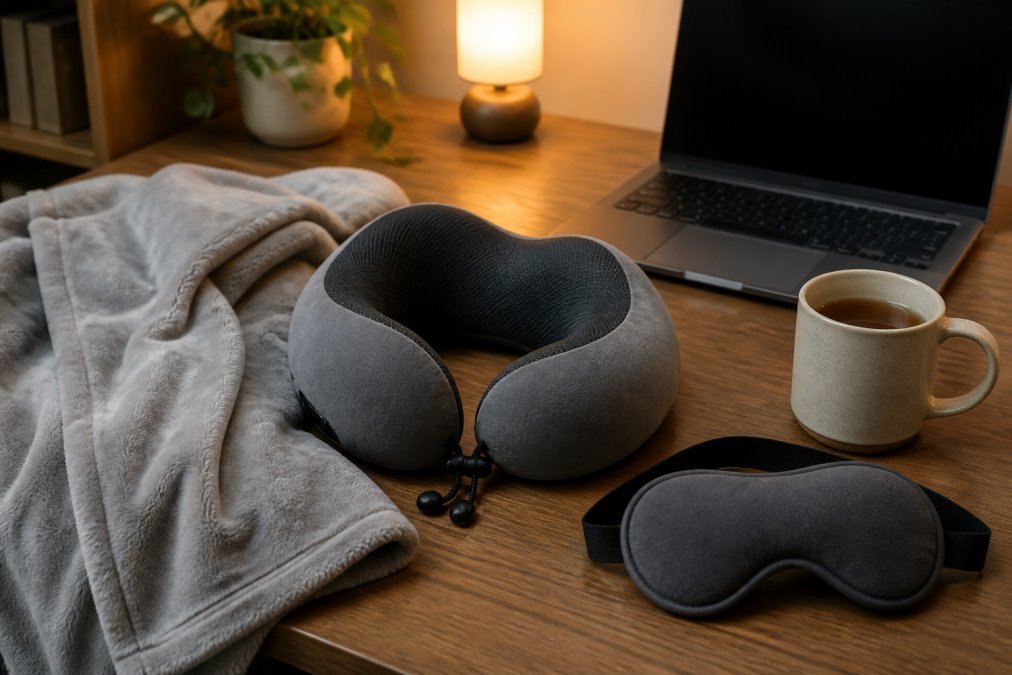
Three items do a surprising amount of heavy lifting. The NeckRelief Pro™ cervical massage pillow (£39.99) targets the neck and shoulder tension that builds after hours of screen time. The Lumo Relief™ heated migraine mask (£18.00) soothes eye strain and tension headaches in about 15 minutes. For cold offices and tense afternoons, the SootheStep™ electric wearable blanket (£59.95) keeps you warm without cranking the heating.


What most reviews miss is that these work best as a routine, not a rescue. Fifteen minutes with the eye mask at lunch does more for an afternoon than an hour of it after a meltdown.
When to Seek Professional Help for Work Stress
Seeking help is the right move when stress starts affecting sleep, appetite, relationships or your ability to function at work for more than a couple of weeks. Those are signals that self-management alone is not enough.
Talk to your GP first. They can assess whether you are experiencing stress, anxiety or depression, and discuss options including talking therapies. In the UK, you can also refer yourself directly to NHS talking therapies without seeing a GP first, via the NHS talking therapies self-referral service. If your employer offers an employee assistance programme, that is another confidential route.
For immediate support, the mental health charity Mind's information line provides guidance on workplace stress and where to turn next.
Frequently Asked Questions
What are the signs of work-related stress?
Common signs include trouble sleeping, constant fatigue, headaches, muscle tension in the neck and shoulders, irritability, and finding it hard to concentrate. You might also notice you are snapping at colleagues or dreading opening your inbox. The Health and Safety Executive (HSE) groups these under six areas: workload, control, support, relationships, role and change. If several of these sound familiar, it is worth acting early rather than waiting for things to worsen.
How can I reduce daily work stress during a busy day?
Start with small, repeatable actions rather than a full overhaul. Try a two-minute breathing exercise between meetings, step away from your screen for a short walk, and write down your top three tasks each morning so you are not reacting to everything at once. Physical comfort matters too: a supportive cushion or a heated eye mask during a break can ease tension that builds up over hours of screen time.
How do I set boundaries at work without seeming difficult?
Be clear and specific rather than emotional. For example, say you will respond to messages between set hours, or that you need to finish one task before taking on another. Most managers respond well to a calm, practical explanation. If you work from home, having a dedicated workspace and a clear end-of-day routine helps reinforce those boundaries so work does not spill into your evening.
When should I seek professional help for workplace stress?
If stress is affecting your sleep, appetite or relationships for more than a few weeks, or if you feel persistently low or anxious, speak to your GP. You can also talk to your employer's HR team or an occupational health adviser. The HSE expects employers to assess and manage work-related stress risks, so raising it at work is a reasonable step, not an overreaction.
Work stress rarely resolves on its own, and waiting for a quiet month that never arrives only deepens the pattern. At Inspree, we curate practical, feel-good products designed to make the small moments of your day easier: a warmer workspace, a calmer lunch break, a neck that finally unclenches. Every order ships securely with tracked and insured delivery, and checkout is protected by SSL encryption. Browse the Inspree wellness range and build a routine that gives your working day back.