

Mindfulness Exercises for Busy Parents at Home
Table of Contents
- Why Mindfulness Matters for Busy Parents
- Quick Mindfulness Exercises You Can Do in Minutes
- Breathing Exercises for Parents During Stressful Moments
- Mindfulness Activities for Children and Families
- Mindful Parenting Techniques for Daily Interactions
- Fitting Mindfulness Into Your Existing Routine
- Creating a Supportive Environment at Home
- Frequently Asked Questions
Last Updated: October 10, 2026
Why Mindfulness Matters for Busy Parents
Being a parent is rewarding. It's also exhausting. Between school runs, meal planning, work deadlines, and bedtime routines, your mind rarely stops. Stress builds up. Sleep suffers. Patience wears thin.
This is where mindfulness exercises for busy parents can make a real difference. Mindfulness isn't about clearing your mind or sitting in silence for an hour. It's about paying attention to what's happening right now, without judgement. Even five minutes changes how you feel.
Research shows that parents who practise mindfulness report feeling calmer and more present with their children. They react less and respond more thoughtfully. They notice small moments instead of rushing through them.
At Inspree, we understand that busy parents need practical solutions that fit into real life. Mindfulness is one of the most powerful tools you can use, and it costs nothing. You don't need special equipment or a quiet room. You just need to pause.
Quick Mindfulness Exercises You Can Do in Minutes
Your schedule is packed. That's why these exercises work. They take two to five minutes. You can do them anywhere. No props needed.
The key is consistency. A two-minute practice every day beats a twenty-minute practice once a month. Your brain adapts to the routine. Calm becomes easier to find.
The Two-Minute Body Scan
A body scan brings your attention to physical sensations. This grounds you in the present moment and releases tension you didn't know you were holding.
Here's how to do it:
- Sit or lie down somewhere comfortable
- Close your eyes
- Start at the top of your head
- Notice any sensations: tingling, warmth, tightness, or nothing at all
- Slowly move your attention down through your body
- Spend about five seconds on each area: forehead, jaw, neck, shoulders, arms, chest, belly, legs, feet
- Don't try to change anything, just notice
This simple mindfulness exercise for busy parents takes two minutes. Do it in the morning before everyone wakes up, or during your lunch break. Your body will feel lighter afterward.
Mindful Pausing Between Tasks
Most parents jump from one task to the next without stopping. Your brain never gets a break. A mindful pause interrupts that cycle.
When you finish one task and before you start another, pause for thirty seconds:
- Stop what you're doing
- Take three slow, deep breaths
- Notice one thing you can see, one you can hear, one you can feel
- Then move to the next task
This tiny reset prevents stress from stacking up. It also helps you be more present in each activity instead of thinking about what's next.
Sensory Awareness Exercise
Your senses anchor you to the present. Use them deliberately.
Pick one sense and focus on it for one minute:
- Sight: Notice five things you can see. Look for details, colours, textures, shapes
- Sound: Listen for sounds in the background. Traffic, birds, a hum from the fridge. Just notice
- Touch: Feel the texture of something nearby, fabric, wood, your own skin
- Smell: Notice what's in the air around you
- Taste: If you're eating or drinking, pay full attention to the flavour
This breaks the autopilot mode. Your mind becomes sharp and present instead of scattered.
Breathing Exercises for Parents During Stressful Moments
Your breath is always available. It's the fastest way to calm your nervous system. When stress hits, these breathing techniques work within seconds.
The 4-7-8 Breathing Technique
This technique activates your body's relaxation response. It works best when you're sitting down.
Follow these steps:
- Exhale completely through your mouth
- Close your mouth and inhale through your nose for a count of four
- Hold your breath for a count of seven
- Exhale slowly through your mouth for a count of eight
- Repeat four times
The longer exhale is key. It signals your nervous system that you're safe. Do this when you feel frustration building or before a difficult conversation with your child.
Box Breathing for Quick Calm
Box breathing is simpler and faster. You can do it anywhere, in the car, at your desk, in the kitchen.
The pattern is simple: four counts in, four counts hold, four counts out, four counts hold. Repeat five times.
This takes two minutes. It steadies your mind and slows your heart rate. Many parents use it right before they respond to a child's misbehaviour instead of reacting in anger.
Alternate Nostril Breathing
This technique balances your nervous system. It's calming but also clarifying.
Here's how:
- Sit upright and relax your shoulders
- Close your right nostril with your right thumb
- Inhale slowly through your left nostril
- Close your left nostril with your ring finger
- Open and exhale through your right nostril
- Inhale through your right nostril
- Close it and exhale through your left
- Repeat for two minutes
This works well in the evening when you want to settle down after a busy day.
Mindfulness Activities for Children and Families
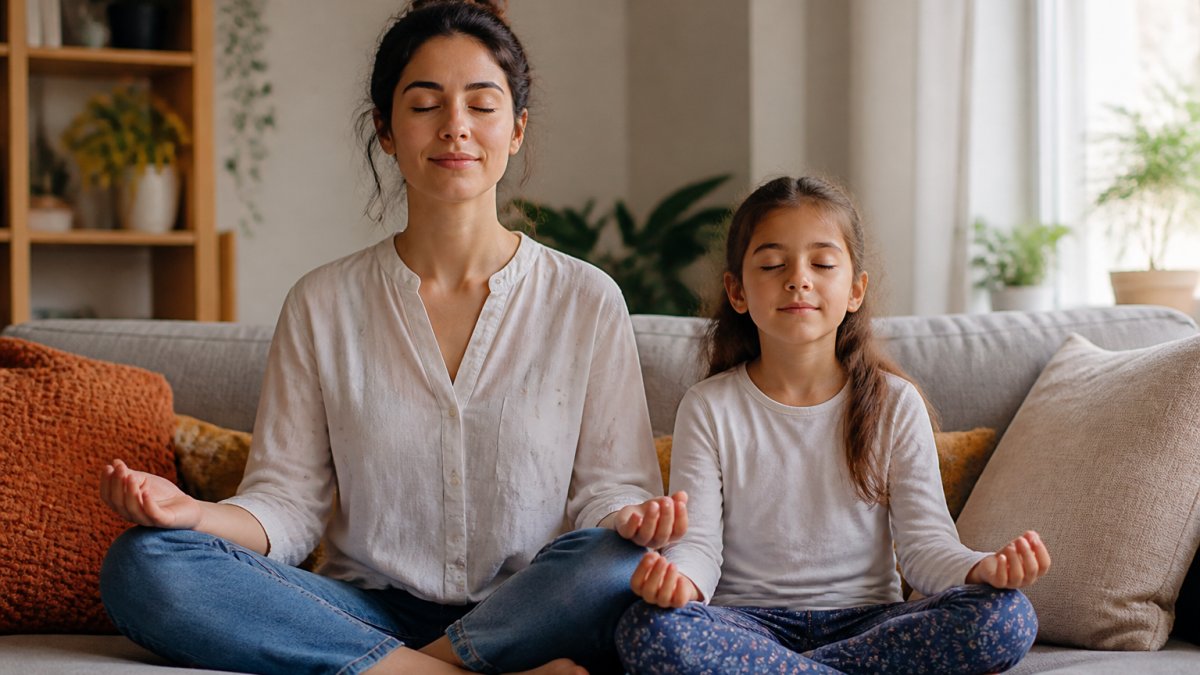
Mindfulness isn't just for you. Practising together with your children creates calm in the whole household. Children learn emotional regulation. You model how to manage stress.
Guided Listening Together
Sit together and listen to a guided meditation designed for families. Many are only five to ten minutes long. Your child follows along. You both relax.
Start with something simple:
- Find a quiet spot
- Sit or lie down together
- Play a guided recording (search "family mindfulness" or "children's meditation")
- Let the voice guide you both through the exercise
- Afterwards, ask your child what they noticed
Children enjoy this because it feels like a shared activity, not a lesson. It also gives you both permission to be still.
Mindful Movement and Stretching
Yoga or simple stretching combines movement with awareness. Children like it because it doesn't feel like sitting still.
Try this five-minute routine together:
- Stand and reach your arms up slowly, noticing how your body feels
- Bend forward gently, feeling your hamstrings stretch
- Twist your torso left and right, moving slowly
- Rotate your shoulders backwards and forward
- Finish with a forward fold, holding for ten breaths
As you move, ask your child to notice what their body feels like. "Does your neck feel tight? Does your back feel better?" This teaches them to listen to their own body.
Five Senses Grounding Game
This game brings everyone into the present moment. It's especially useful when a child is upset or anxious.
Ask your child to name:
- Five things they can see
- Four things they can touch
- Three things they can hear
- Two things they can smell
- One thing they can taste
This shifts their attention away from worry and into their immediate surroundings. It calms the nervous system quickly.
Mindful Parenting Techniques for Daily Interactions
How you respond to your child matters more than what you say. Mindfulness changes your responses. You become calmer, more patient, more present.
Presence Without Distraction
When your child talks to you, put your phone away. Make eye contact. Listen without planning your response.
This sounds simple. It's harder than it seems. Your mind wanders. You think about dinner or an email.
When you notice your mind has wandered, gently bring it back. Listen to the actual words your child is saying, not what you think they mean. Notice their expression and tone.
This takes practice. But children feel the difference immediately. They know when you're really listening.
Responding Rather Than Reacting
Reacting is automatic. Your child spills juice. You yell. Your child talks back. You punish immediately.
Responding is different. There's a pause between what happens and what you do.
When something frustrating happens:
- Pause for three seconds
- Take one deep breath
- Notice what you're feeling without acting on it
- Then choose your response
This pause is mindfulness in action. It gives you space to be the parent you want to be instead of the one stress makes you become.
Fitting Mindfulness Into Your Existing Routine
You don't need to add mindfulness to your schedule. You already have pockets of time. Use them.
Morning routine: Do a two-minute body scan while you wait for your coffee.
Commute: Use breathing exercises instead of checking your phone.
Lunch break: Take five minutes for mindful eating. Taste your food instead of rushing.
Bedtime: Practise alternate nostril breathing as you lie in bed.
Bath time: Use this as a sensory awareness exercise. Notice the warmth, the sound of water, the smell of soap.
These moments already exist. You're just using them differently.
The trick is linking mindfulness to something you already do. Your brain remembers the connection. Soon, you'll automatically pause and breathe during these moments.
Creating a Supportive Environment at Home
Your physical space affects your mind. A calm home makes mindfulness easier.
Simple changes help:
- Reduce clutter in one room where you can sit quietly
- Open curtains to let in natural light
- Play soft background music or nature sounds during calm times
- Keep your phone in another room during family time
- Light a candle or use a diffuser with a scent you love
These aren't essential. But they signal to your brain that this is a calm space. Your nervous system relaxes.
At Inspree, we know that the right products can support your wellness routine. A comfortable cushion, soft lighting, or a beautiful candle can make your mindfulness practice feel special instead of like another chore.
You don't need much. But what you have should feel good to use.
Frequently Asked Questions
What are some simple mindfulness exercises for busy parents?
Simple exercises include the two-minute body scan (noticing physical sensations from head to toe), mindful pausing between tasks (stopping for three conscious breaths), and sensory awareness (focusing on what you see, hear, and feel). These require no equipment and fit into daily routines like morning coffee time, waiting for the kettle, or before bed. Start with just one exercise and build from there rather than trying everything at once.
How long should a mindfulness exercise last for busy parents?
Even two to three minutes makes a meaningful difference. Box breathing takes about four minutes, whilst the 4-7-8 technique works in five. You don't need lengthy sessions to experience benefits. Consistency matters more than duration, so a quick daily practice beats occasional longer sessions. Many busy parents find success with micro-practices scattered throughout the day rather than one dedicated block.
Can I practise mindfulness exercises at home with children around?
Yes. Involve your children in mindfulness activities for children and families, such as guided listening or five senses grounding games, which turn stress-reduction into shared time. Alternatively, practise during quiet moments: early morning before everyone wakes, during children's screen time, or whilst they play independently. Some parents use children's bedtime routines as their own practise opportunity, combining parenting duties with personal calm.
What should I do when I feel overwhelmed as a parent?
Use breathing exercises for parents designed for immediate relief, such as box breathing or alternate nostril breathing, which calm your nervous system within minutes. Step away briefly if possible, even for a bathroom break. Apply mindful parenting techniques by pausing before responding to your child, which prevents reactive behaviour. If overwhelm is frequent, consistent daily practise builds your resilience over time.
Mindfulness for busy parents isn't about finding more time. It's about using the time you have differently. Two minutes of real presence beats an hour of distracted rushing. Start today with just one of these mindfulness exercises for busy parents. Notice how you feel. Then add another. Your family will notice the change in you before you fully notice it yourself.